
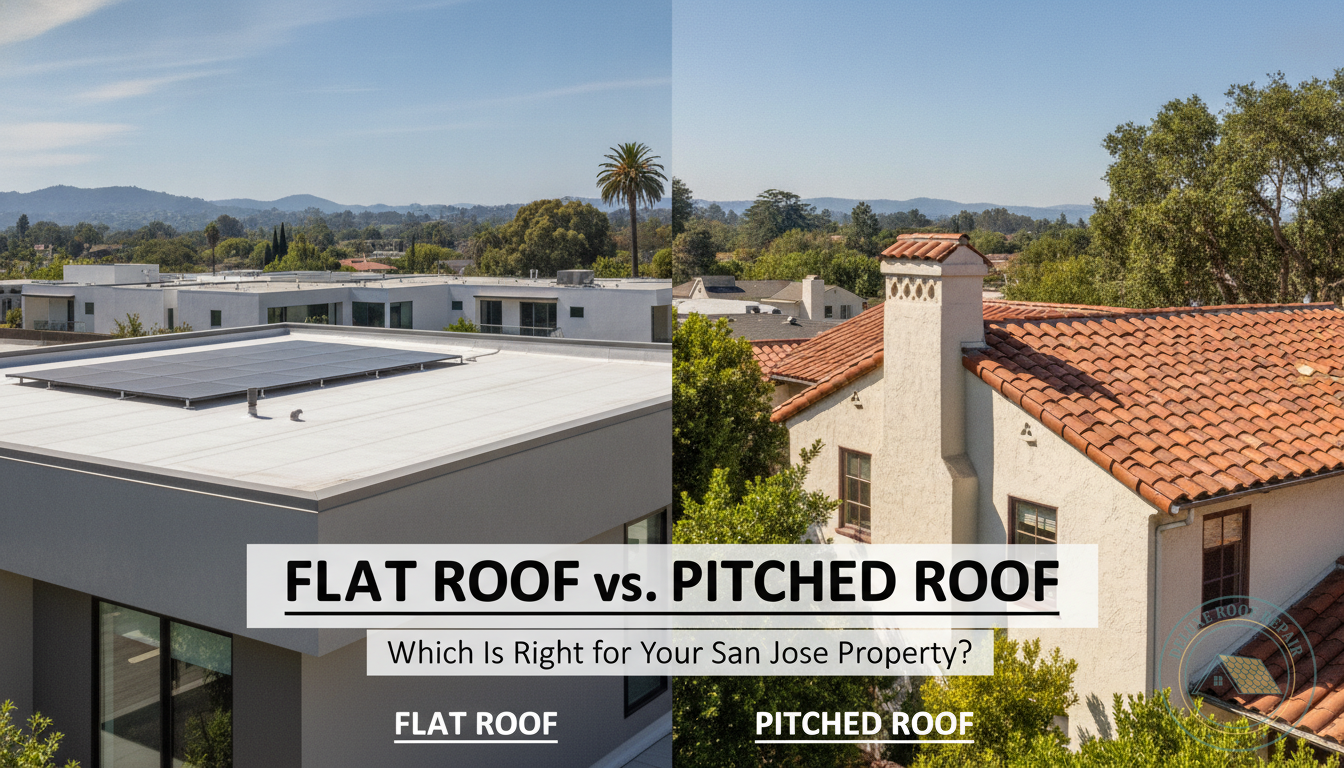
Understanding Your Roofing Options in the Bay Area
Whether you're planning a new construction project, replacing an aging roof on an existing home, or adding a room addition to your San Jose property, one of the most fundamental decisions you'll face is the choice between a flat (low-slope) and pitched roofing system. Both have distinct advantages and limitations, and the right choice depends on your building's structure, your budget, your aesthetic preferences, and how you plan to use the space below and potentially above the roof.
At Deluxe Roof Repair — San Jose, we work on both roofing systems every day — from tile and shingle repairs on the craftsman homes of Willow Glen to flat roof membrane repairs and coatings on light commercial properties and residential additions across the city. Here's what every San Jose property owner should understand before making this decision.
What Defines a Flat Roof vs. a Pitched Roof?
In roofing terminology, a "flat" roof is technically a low-slope roof — typically with a pitch of 2:12 or less (meaning 2 inches of vertical rise for every 12 inches of horizontal run). True zero-slope roofs are rare because even flat roofing systems require some degree of slope to promote drainage. A "pitched" roof, by contrast, refers to any roof with a slope steeper than 2:12, with most residential roofs in San Jose falling in the 4:12 to 8:12 range.
The distinction matters because the two systems use entirely different materials, waterproofing strategies, and drainage approaches — and they have very different maintenance profiles as a result.
Flat Roofs: Pros and Cons for San Jose Properties
Advantages of Flat Roofing
- Lower upfront installation cost: Flat roofing systems generally require less material and less labor to install than comparable pitched systems, making them attractive for large commercial footprints or residential additions where budget is a priority.
- Usable rooftop space: A flat roof can accommodate HVAC equipment, solar panels, rooftop decks, and green roof installations — possibilities that don't exist on a steep pitched roof.
- Easier access for maintenance: Flat roofs are far safer and simpler to walk on for routine inspections, equipment servicing, and minor repairs than steeply pitched surfaces.
- Modern architectural aesthetic: Contemporary and mid-century modern homes, as well as many light commercial buildings throughout San Jose, use flat rooflines as a defining design element.
Disadvantages of Flat Roofing
- Drainage challenges: The limited slope means water drains more slowly, increasing the risk of ponding — standing water that accelerates membrane degradation and adds structural load to the deck.
- Higher maintenance frequency: Flat roofing membranes require more regular inspection and maintenance than pitched shingle systems, particularly at seams, penetrations, and drain points.
- Shorter membrane lifespan: Most flat roofing membranes have a service life of 15 to 25 years with proper maintenance, compared to 25 to 50 years for quality pitched roofing systems.
- Ponding water risk: Even minor settlement or deck deflection can create low spots where water accumulates. Ponding water that sits for more than 48 hours will degrade virtually any membrane material over time.
If you own a property with a flat or low-slope roofing system in San Jose, our flat roof repair and coating services are designed to address the most common failure points — blistering, seam separation, and membrane crazing — and extend your system's life through reflective elastomeric coatings that also reduce summer heat gain.
Pitched Roofs: Pros and Cons for San Jose Homes
Advantages of Pitched Roofing
- Superior natural drainage: The slope of a pitched roof moves water rapidly off the surface and into gutters, dramatically reducing the dwell time that causes deterioration and leak risk.
- Longer material lifespan: Architectural asphalt shingles typically carry 30-year warranties, while tile roofing systems common in San Jose's Mediterranean-climate neighborhoods can last 50 years or more with proper maintenance.
- Attic space and ventilation: A pitched roof creates usable attic volume that can be conditioned for storage or finished living space, and the air gap between the roof deck and insulation allows for critical ventilation that manages heat and moisture.
- Wide material selection: Pitched roofs can be clad in asphalt shingles, concrete or clay tile, metal panels, and more — giving homeowners in neighborhoods like Evergreen and Berryessa flexibility to match their home's character and HOA requirements.
Disadvantages of Pitched Roofing
- Higher installation cost: The additional materials, safety equipment, and labor required for steeper pitch work make pitched roof installations more expensive per square foot than flat systems.
- Wind uplift vulnerability: Steep roof surfaces present more area for wind to act upon, and shingle edges can lift or tear away during strong gusts if fastening is inadequate or shingles have aged past their flexibility threshold.
- Flashing complexity: Every penetration — chimney, skylight, dormer, plumbing vent — requires carefully formed and sealed flashing that must be maintained over the roof's life. Our flashing repair team handles these high-failure-risk intersections regularly throughout San Jose.
Maintenance Differences That Matter in San Jose's Climate
San Jose's Mediterranean climate — characterized by warm, dry summers and cool, wet winters — creates a specific pattern of stress for both roofing types. For pitched roofs, the dry season causes asphalt shingles to lose flexibility and granules, while sealants around flashings dry out and crack. For flat roofs, UV exposure during the long dry season degrades membrane surfaces, and the first heavy rains of fall test every seam and drain.
For both systems, a professional inspection in late September or early October — before the rainy season begins — is one of the most cost-effective maintenance habits a San Jose property owner can adopt. Catching a failed pipe boot or a separated membrane seam before the first major rain prevents interior water damage that costs far more to remediate than the repair itself.
Our team provides roof leak detection services that work equally well on pitched and flat systems, using physical evidence of water pathways to pinpoint sources before they cause visible interior damage.
When to Repair vs. When to Replace
Regardless of which roofing type you have, the decision between repair and replacement follows similar logic. If damage is localized — a section of failed membrane on a flat roof, or a cluster of cracked shingles on a pitched one — targeted repair is almost always the more economical choice. When damage is widespread, or when the system is approaching or past its expected service life, a full roof replacement delivers better long-term value than repeated patch repairs on a failing system.
We serve property owners across San Jose and neighboring communities including Campbell and
Call +16692192228 or fill out our online form for a free, no-obligation quote.Discuss This With Our Team