
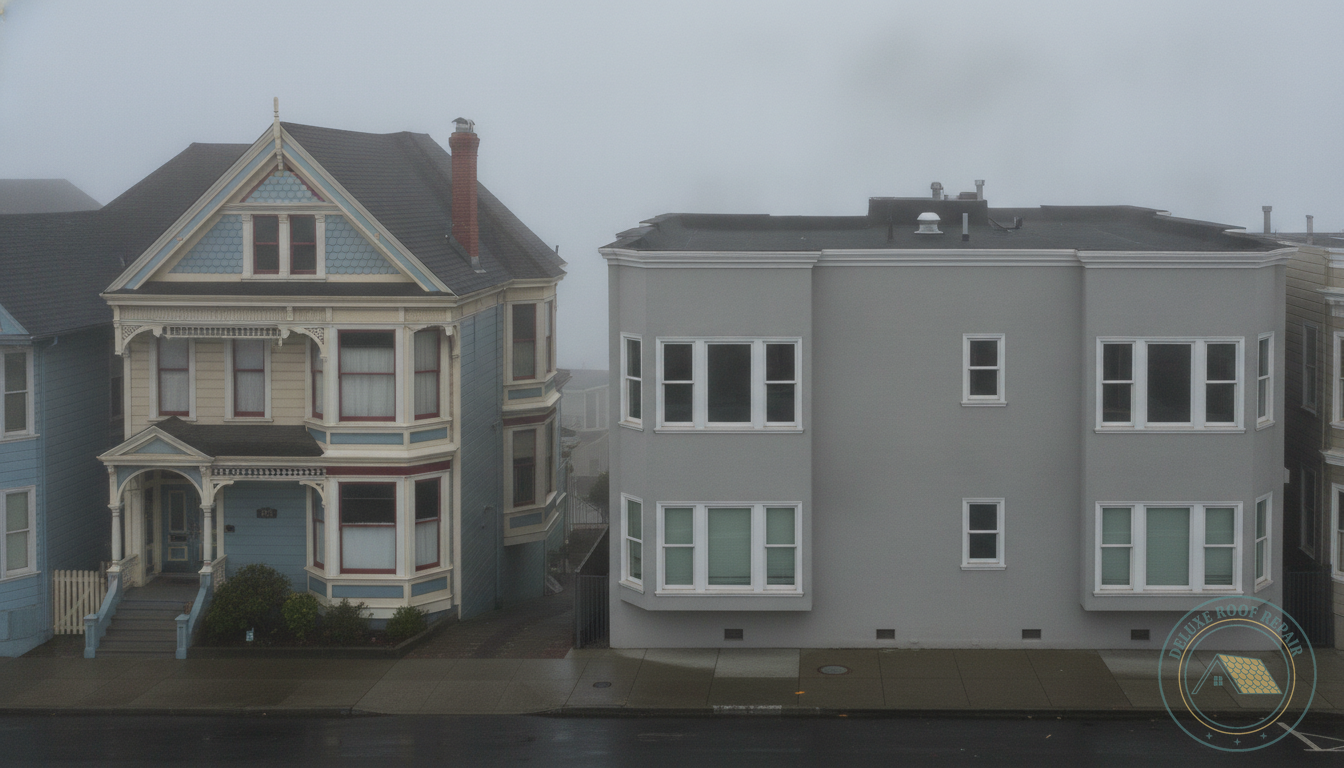
Walk through almost any San Francisco neighborhood and you'll see both worlds side by side: a steeply pitched Victorian with ornate cornices next to a boxy Edwardian flat with a nearly level roofline. Both architectural styles are beloved — and both present distinct roofing challenges shaped by the city's marine climate. At Deluxe Roof Repair, we work on both roof types every week, and homeowners often ask us which one demands more attention. The honest answer is: they're different, not necessarily one more than the other. Here's what you need to know about each.
How Flat Roofs Work — and Where They Fail
A flat or low-slope roof doesn't actually drain by gravity the way a pitched roof does. Instead, it relies on a continuous waterproof membrane — typically modified bitumen, TPO, or built-up roofing (BUR) — to hold water until it finds a drain, scupper, or sufficient slope to run off. That continuous membrane is the entire defense against water intrusion, which means any breach, open seam, or ponding water zone becomes a direct leak path.
The most common flat roof failures we see on San Francisco's Edwardian flats and TIC buildings include:
- Open membrane laps — seams between sheets separate as the material ages or expands and contracts through temperature cycles
- Blistering and bubbling — trapped moisture vapor beneath the membrane lifts the surface, creating weak spots prone to puncture
- Cracked parapet cap flashing — the metal or rubberized cap at the top of the parapet wall corrodes and separates, allowing water to enter the wall assembly
- Ponding water — standing water after rain is normal for up to 48 hours, but persistent ponding accelerates membrane degradation significantly
- Deteriorated roof drains and scuppers — clogged or corroded drains trap water on the surface, compounding ponding issues
Because flat roof failures are often invisible from the street, many San Francisco building owners don't know there's a problem until a stain appears on a top-floor ceiling. Our flat roof repair and coating service addresses all of these failure points, and an elastomeric reflective coating can restore waterproofing on membranes that are structurally sound but showing surface aging — extending service life by 10 to 15 years without a full tear-off.
How Pitched Roofs Work — and Where They Fail
Asphalt shingle, clay tile, and concrete tile pitched roofs shed water through gravity and overlapping layers of material. The system is inherently more forgiving of minor surface breaches because water has multiple barriers — shingle, underlayment, ice-and-water membrane at the eaves — before reaching the sheathing. However, pitched roofs have their own set of high-risk zones.
On San Francisco's Victorian and mid-century homes, we most frequently find:
- Failed chimney and skylight flashing — the joints between the roof surface and vertical penetrations are the single most common source of pitched roof leaks
- Cracked vent boots — rubber collars around plumbing stack vents degrade in UV and salt air and need replacement every 10 to 15 years
- Lifted or missing shingles — wind-driven rain in exposed neighborhoods like the Outer Sunset can separate improperly fastened tabs
- Granule loss — asphalt shingles lose protective mineral granules as they age, reducing UV resistance and eventually exposing the asphalt core to water
- Valley deterioration — the V-shaped intersection where two roof planes meet concentrates water flow and wears faster than the surrounding field
The good news for pitched roof owners is that many of these issues are repairable in isolation. A failed flashing, cracked vent boot, or small section of damaged shingles rarely requires a full replacement. Our roof flashing repair and roof leak repair services are specifically designed to address these targeted failures efficiently. When deterioration is widespread — typically when more than 30 to 40 percent of the surface is compromised — a full shingle roof replacement becomes the more cost-effective path.
Maintenance Frequency: What Both Roof Types Need
Regardless of roof type, the single most protective thing a San Francisco homeowner can do is schedule periodic professional inspections. We recommend:
- Every 2 to 3 years for roofs under 15 years old in good condition
- Annually for roofs over 15 years old or after any significant storm event
- Before and after major real estate transactions to document condition for buyers, sellers, and insurance carriers
Our roof inspection service delivers a written report with photos and a zone-by-zone condition rating so you always know exactly where your roof stands. We also inspect gutters and downspouts as part of every assessment — because a failed gutter system can undermine an otherwise healthy roof by allowing water to back up at the eave or saturate the fascia.
Don't Forget Gutters — for Both Roof Types
Both flat and pitched roofs rely on properly functioning gutters and downspouts to carry runoff away from the building. San Francisco's concentrated winter storms deliver high volumes of water in short periods, and an undersized, sagging, or clogged gutter quickly overwhelms the system. Rotted fascia, foundation dampness, and landscape erosion are common consequences. We install seamless aluminum gutters in K-style and half-round profiles that complement the architectural details of historic SF homes while standing up to the salt-air coastal environment.
Serving San Francisco and the Surrounding Bay Area
Whether your home is a flat-roofed Edwardian in Hayes Valley or a steep Victorian in Noe Valley, Deluxe Roof Repair has the materials and expertise to keep it watertight. We also serve neighboring communities including Oakland, Emeryville, and Daly City. Call us at +1 (628) 888-6069 — we're available Monday through Sunday, 8:00 AM to 6:00 PM — or email [email protected] to schedule an inspection or estimate.
Discuss This With Our Team
Call +16288886069 or fill out our online form for a free, no-obligation quote.
Request Free Quote